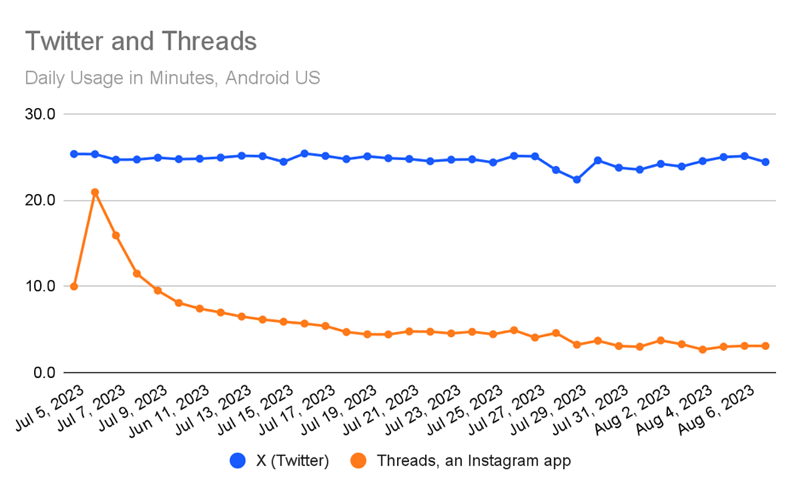
<?xml version="1.0" encoding="utf-8"?><feed xmlns="http://www.w3.org/2005/Atom"><generator uri="https://jekyllrb.com/" version="4.4.1">Jekyll</generator><link href="https://contentmonkey.com.au/feed.xml" rel="self" type="application/atom+xml"/><link href="https://contentmonkey.com.au/" rel="alternate" type="text/html"/><updated>2025-03-02T11:26:50+00:00</updated><id>https://contentmonkey.com.au/feed.xml</id><title type="html">Content Monkey</title><subtitle>Des Devlin and Deborah Shaw</subtitle><author><name>Content Monkey</name></author><entry><title type="html">Race heats up as Twitter quitters become ex-Xers</title><link href="https://contentmonkey.com.au/posts/race-heats-up-as-twitter-quitters-become-ex-xers/" rel="alternate" type="text/html" title="Race heats up as Twitter quitters become ex-Xers"/><published>2023-08-30T00:00:00+00:00</published><updated>2023-08-30T00:00:00+00:00</updated><id>https://contentmonkey.com.au/posts/race-heats-up-as-twitter-quitters-become-ex-xers</id><content type="html" xml:base="https://contentmonkey.com.au/posts/race-heats-up-as-twitter-quitters-become-ex-xers/"><![CDATA[<p>Given the almost daily announcements recently from the world of social media, we thought we’d follow up on our <a href="https://contentmonkey.com.au/posts/twitter-on-the-ropes-with-the-launch-of-threads/" target="_blank" rel="noopener">last post</a> which looked at Meta’s tilt at Twitter, now ‘X’. </p><p> After its massive initial surge in sign-ups, usage of Meta’s rival app Threads has <a href="https://time.com/6305383/meta-threads-failing/" target="_blank" rel="noopener">plummeted 80 per cent.</a> </p><p> <img class="img-embed" src="/img/posts/similarweb-800.png" alt="Graph showing Twitter vs Threads daily usage"/> <br/> <small>Source: similarweb</small> </p><p> Threads made signing up easy for those with an Instagram account but not so for many X users who found the app comparatively featureless. </p><p> With the heat on to stay in the game, Threads has been tweaking as fast as it can, announcing a <a href="https://gizmodo.com.au/2023/08/threads-gets-a-couple-more-twitter-like-features/" target="_blank" rel="noopener">repost feature</a> and in recent days launching a <a href="https://www.zdnet.com/article/metas-threads-website-is-now-live-for-everyone/" target="_blank" rel="noopener">web-based version</a>. </p><p> Oddly, just as Threads piles on new features, X has been removing them. </p><p> Having already torpedoed a chunk of his social media platform’s functionality, Elon Musk recently floated the idea of deleting X’s block feature. </p><p> Some users, including anti-bullying activist Monica Lewinsky, immediately suggested the tetchy tech bro <a href="https://twitter.com/MonicaLewinsky/status/1692697894929785246" target="_blank" rel="noopener">rethink the idea</a>. Forbes contributor John Koetsier called the idea <a href="https://www.forbes.com/sites/johnkoetsier/2023/08/18/uproar-on-x-elon-musk-says-blocking-users-will-be-deleted/" target="_blank" rel="noopener">shocking</a>: “The result is likely to be even more division, anger, and harassment on the platform.” </p><p> Musk argues X’s mute function will be adequate (albeit after some beefing up) while at the same time conceding the platform could, as predicted, <a href="https://www.businessinsider.com/elon-musk-admits-x-twitter-may-fail-predictions-2023-8" target="_blank" rel="noopener">be doomed</a>. </p><p> Ad placement and lack of content moderation continue to plague X, with brands again <a href="https://edition.cnn.com/2023/08/16/tech/x-ads-pro-nazi-account-brand-safety/index.html" target="_blank" rel="noopener">pulling advertising</a> from the platform. </p><p> However, as brands start to build a presence on Threads, ad space on the app remains unavailable. Marketers may also be looking at Threads’ parent company Meta, owner of Facebook, which has been <a href="https://www.smh.com.au/national/meta-rules-online-racism-against-indigenous-people-meets-community-standards-20230815-p5dwqt.html" target="_blank" rel="noopener">criticised</a> for its laissez-faire approach to content moderation. (There are also some continued privacy concerns restricting access in the EU.) </p><p> Contrast that with rival BlueSky who has begun pursuing revenue directions <a href="https://blueskyweb.xyz/blog/7-05-2023-business-plan" target="_blank" rel="noopener">other than advertising</a>, such as <a href="https://blueskyweb.xyz/blog/3-6-2023-domain-names-as-handles-in-bluesky" target="_blank" rel="noopener">custom domains</a>. The platform remains in beta, with sign-ups restricted to a waitlist for those without an invite code. Though if it launches fully-formed, it may succeed where Threads, by going too early, has (so far) failed. </p><p> X’s other notable rival, Mastodon, continues to take on disenchanted users, who may be forgiven for thinking they’ve fled an autocracy only to land in a fiefdom as users battle with moderators over issues such as <a href="https://fosstodon.org/@mairin/110932260818350698" target="_blank" rel="noopener">lack of multi-lingual support</a>, or just feel generally <a href="https://erinkissane.com/mastodon-is-easy-and-fun-except-when-it-isnt" target="_blank" rel="noopener">unwelcome</a>. </p><p> Interestingly, Threads has committed to using ‘ActivityPub’, the protocol underlying Mastodon and other ‘federated’ platforms. </p><p> “Soon, you'll be able to follow and interact with people on other fediverse platforms, like Mastodon”, Threads states. </p><p> BlueSky, on the other hand, is building its own ‘AT Protocol’ which it claims will be a bigger, better federated protocol. </p><p> Confused yet? </p><p> In short, as Threads bulks up on features, it may grab enough user share to head off BlueSky before its expected launch in the coming months. </p><p> For marketers, regardless of how BlueSky’s ambitious, ad-free business model plays out, some assurances around content moderation would likely be a deciding factor in who comes out on top in a post-X social media world. </p><p> <strong>Related</strong>:<br/> <a href="https://opensource.com/article/23/3/tour-the-fediverse" target="_blank" rel="noopener">A 5-minute tour of the Fediverse</a><br/> <a href="https://www.theverge.com/2023/4/20/23689570/activitypub-protocol-standard-social-network" target="_blank" rel="noopener">Can ActivityPub save the internet?</a><p>]]></content><author><name>Content Monkey</name></author><summary type="html"><![CDATA[Given the almost daily announcements recently from the world of social media, we thought we’d follow up on our last post which looked at Meta’s tilt at Twitter, now ‘X’. After its massive initial surge in sign-ups, usage of Meta’s rival app Threads has plummeted 80 per cent. Source: similarweb Threads made signing up easy for those with an Instagram account but not so for many X users who found the app comparatively featureless. With the heat on to stay in the game, Threads has been tweaking as fast as it can, announcing a repost feature and in recent days launching a web-based version. Oddly, just as Threads piles on new features, X has been removing them. Having already torpedoed a chunk of his social media platform’s functionality, Elon Musk recently floated the idea of deleting X’s block feature. Some users, including anti-bullying activist Monica Lewinsky, immediately suggested the tetchy tech bro rethink the idea. Forbes contributor John Koetsier called the idea shocking: “The result is likely to be even more division, anger, and harassment on the platform.” Musk argues X’s mute function will be adequate (albeit after some beefing up) while at the same time conceding the platform could, as predicted, be doomed. Ad placement and lack of content moderation continue to plague X, with brands again pulling advertising from the platform. However, as brands start to build a presence on Threads, ad space on the app remains unavailable. Marketers may also be looking at Threads’ parent company Meta, owner of Facebook, which has been criticised for its laissez-faire approach to content moderation. (There are also some continued privacy concerns restricting access in the EU.) Contrast that with rival BlueSky who has begun pursuing revenue directions other than advertising, such as custom domains. The platform remains in beta, with sign-ups restricted to a waitlist for those without an invite code. Though if it launches fully-formed, it may succeed where Threads, by going too early, has (so far) failed. X’s other notable rival, Mastodon, continues to take on disenchanted users, who may be forgiven for thinking they’ve fled an autocracy only to land in a fiefdom as users battle with moderators over issues such as lack of multi-lingual support, or just feel generally unwelcome. Interestingly, Threads has committed to using ‘ActivityPub’, the protocol underlying Mastodon and other ‘federated’ platforms. “Soon, you'll be able to follow and interact with people on other fediverse platforms, like Mastodon”, Threads states. BlueSky, on the other hand, is building its own ‘AT Protocol’ which it claims will be a bigger, better federated protocol. Confused yet? In short, as Threads bulks up on features, it may grab enough user share to head off BlueSky before its expected launch in the coming months. For marketers, regardless of how BlueSky’s ambitious, ad-free business model plays out, some assurances around content moderation would likely be a deciding factor in who comes out on top in a post-X social media world. Related: A 5-minute tour of the Fediverse Can ActivityPub save the internet?]]></summary></entry><entry><title type="html">Twitter on the ropes with the launch of Threads</title><link href="https://contentmonkey.com.au/posts/twitter-on-the-ropes-with-the-launch-of-threads/" rel="alternate" type="text/html" title="Twitter on the ropes with the launch of Threads"/><published>2023-07-11T00:00:00+00:00</published><updated>2023-07-11T00:00:00+00:00</updated><id>https://contentmonkey.com.au/posts/twitter-on-the-ropes-with-the-launch-of-threads</id><content type="html" xml:base="https://contentmonkey.com.au/posts/twitter-on-the-ropes-with-the-launch-of-threads/"><![CDATA[<p>With over 100 million sign-ups in the few days since its release, Meta’s Threads is shaping up to be the social app that finally lays Twitter to rest. </p><p> Not that there haven’t been contenders. Bluesky and Mastodon were among a handful hyped as viable replacements. And that’s the thing – with little fanfare in the lead up to its release, Threads appears to have effortlessly demolished its rival, Twitter, which has fallen into critical entropy. </p><p> Though widely mistrusted, Meta is nonetheless a known entity. It has made the transition to Threads easy via Instagram, which has 2 billion monthly active users. </p><p> For those in the media and communications space, Twitter was the go-to platform for sharing news and information. It was a boon to financial PR and media relations professionals because it brought together an array of constituents from the sector, from journalists and bloggers to marketers and entrepreneurs to advisers, analysts, fund managers and data geeks. </p><p> Threads may return needed stability on social not only to the financial media but to business and brands more generally. </p><p> Although occasionally chaotic, pre-Musk Twitter was still mostly coherent and usable. Yes, trolling was a growing problem, but it seemed the company was making a genuine effort to contain it and to fix its increasingly <a href="https://www.forbes.com/sites/petersuciu/2022/06/08/twitter-tops-the-list-of-most-toxic-apps/">toxic image</a>. Or at least give the appearance of trying. </p><p> But Twitter has now become too hostile an environment for many, with scientists the latest cohort to <a href="https://www.news.com.au/breaking-news/climate-scientists-flee-twitter-as-hostility-surges/news-story/748280baa9a472ab738bf46ff2f343f3">flee the platform</a>. Many businesses and brands have either shied away or <a href="https://www.vulture.com/article/twitter-companies-quit-tweets-list.html">quit</a>. </p><p> <strong>Twitter’s demise</strong> </p><p> Advertising provided 90 per cent of Twitter’s revenues, so for someone who <a href="https://www.nytimes.com/2022/05/05/business/media/elon-musk-twitter-ads.html">admittedly hates advertising</a> to take control, the company’s financial woes were probably going to be inevitable. </p><p> Advertisers started deserting the platform late last year and were <a href="https://www.vox.com/technology/2023/3/23/23651151/twitter-advertisers-elon-musk-brands-revenue-fleeing">not coming back</a> anytime soon. Revenue was down 40% y-o-y in December 2022 with <a href="https://www.searchenginejournal.com/twitters-revenue-down-40-as-500-top-advertisers-pull-out/476810/">ad revenue decreasing by 40</a> per cent. The company’s top<strong> </strong>1,000 advertisers in September 2022 were <a href="https://edition.cnn.com/2023/02/10/tech/twitter-top-advertiser-decline/index.html">no longer spending</a> by January. Its ad revenue was forecast down this year by <a href="https://www.reuters.com/technology/twitters-advertising-business-seen-facing-slow-recovery-2023-04-13">37 per cent</a>. </p><p> As of June 2023, US ad sales were down <a href="https://www.nytimes.com/2023/06/05/technology/twitter-ad-sales-musk.html">59 per cent</a>. </p><p> The appointment of ad sales ninja Linda Yaccarino as new CEO made sense. But questions remain as to how she can revive the company’s revenues without first restoring trust. </p><p> And the solutions to Twitter’s trust problems weren’t rocket science. The market had simply wanted <a href="https://www.npr.org/2022/12/08/1141568738/chaos-reigns-at-twitter-as-musk-manages-by-whims">basic content moderation</a>. </p><p> If there was ever an example of why business is as much about culture as it is financials, Twitter is it. Advertisers don’t want to risk their clients being associated with the wrong crowd. </p><p> In the free market of ideas, it is expected that the playing field be dynamic and robust, but it also needs to be logical and relatively reliable. Business likes some semblance of order with their disruption! </p><p> <strong>Towards a decentralised social model</strong> </p><p> In the end, Threads has provided a lifeboat for the existing model of social networking. But in many ways, it is a legacy model. </p><p> Social as we know it is changing fast, and it may not be over for Musk, who has been developing an ‘everything app’ called simply the X app, an all-in-one offering along the lines of WeChat. </p><p> The next iteration of social (yes, we’re crystal gazing now) may be understood in the concept of the microapp, which enables a seamlessly integrated and ubiquitous world of ‘socialised’ data points or nodes. To understand the concept a little better it is worth considering the case of Linux: the operating system never took over desktop computing but was revolutionary in powering the internet of things (IoT) and the interconnectivity of devices. </p><p> In the same way, social may disintegrate but reappear in decentralised forms in everyday digital life. </p><p> This may pose a problem for those social media companies who rely on capturing users (the product) in a singular, centralised environment. </p><p> Some argue that there’s method to the Twitter debacle, that it’s a planned implosion. Tech journalist Casey Newton, for example, <a href="https://www.npr.org/2022/12/08/1141568738/chaos-reigns-at-twitter-as-musk-manages-by-whims">has commented</a> that Musk’s end game for Twitter is “to blow it up and start over”. </p><p> In other words, Musk is destroying Twitter in order to save it. </p><p> Whichever way it plays out, the next generation of social, of microapps and open, portable protocols, is sure to make substantial use of video, which, <a href="https://www.insiderintelligence.com/content/video-now-accounts-over-half-of-all-social-network-ad-revenues">according to Evelyn Mitchell </a>of Insider Intelligence, “now accounts for over half of all social network ad revenues”. </p><p> It will also likely integrate a digital currency transaction layer – something Musk has had <a href="https://www.ft.com/content/9d84d534-b2dd-4cff-85d1-aee137b26a45">on the cards</a> for Twitter, possibly via an in-app <a href="https://cointelegraph.com/news/more-details-emerge-on-twitter-coins-and-crypto-s-not-included">Twitter Coin</a>. </p><p> So, Threads Coin, anyone? </p><p> <blockquote class="instagram-media" data-instgrm-captioned data-instgrm-permalink="https://www.instagram.com/p/CuYNvTSLFWw/?utm_source=ig_embed&amp;utm_campaign=loading" data-instgrm-version="14" style=" background:#FFF; border:0; border-radius:3px; box-shadow:0 0 1px 0 rgba(0,0,0,0.5),0 1px 10px 0 rgba(0,0,0,0.15); margin: 1px; max-width:540px; min-width:326px; padding:0; width:99.375%; width:-webkit-calc(100% - 2px); width:calc(100% - 2px);"><div style="padding:16px;"> <a href="https://www.instagram.com/p/CuYNvTSLFWw/?utm_source=ig_embed&amp;utm_campaign=loading" style=" background:#FFFFFF; line-height:0; padding:0 0; text-align:center; text-decoration:none; width:100%;" target="_blank" rel="noopener"> <div style=" display: flex; flex-direction: row; align-items: center;"> <div style="background-color: #F4F4F4; border-radius: 50%; flex-grow: 0; height: 40px; margin-right: 14px; width: 40px;"></div> <div style="display: flex; flex-direction: column; flex-grow: 1; justify-content: center;"> <div style=" background-color: #F4F4F4; border-radius: 4px; flex-grow: 0; height: 14px; margin-bottom: 6px; width: 100px;"></div> <div style=" background-color: #F4F4F4; border-radius: 4px; flex-grow: 0; height: 14px; width: 60px;"></div></div></div><div style="padding: 19% 0;"></div> <div style="display:block; height:50px; margin:0 auto 12px; width:50px;"><svg width="50px" height="50px" viewBox="0 0 60 60" version="1.1" xmlns="https://www.w3.org/2000/svg" xmlns:xlink="https://www.w3.org/1999/xlink"><g stroke="none" stroke-width="1" fill="none" fill-rule="evenodd"></g><g transform="translate(-511.000000, -20.000000)" fill="#000000"></g><g><path d="M556.869,30.41 C554.814,30.41 553.148,32.076 553.148,34.131 C553.148,36.186 554.814,37.852 556.869,37.852 C558.924,37.852 560.59,36.186 560.59,34.131 C560.59,32.076 558.924,30.41 556.869,30.41 M541,60.657 C535.114,60.657 530.342,55.887 530.342,50 C530.342,44.114 535.114,39.342 541,39.342 C546.887,39.342 551.658,44.114 551.658,50 C551.658,55.887 546.887,60.657 541,60.657 M541,33.886 C532.1,33.886 524.886,41.1 524.886,50 C524.886,58.899 532.1,66.113 541,66.113 C549.9,66.113 557.115,58.899 557.115,50 C557.115,41.1 549.9,33.886 541,33.886 M565.378,62.101 C565.244,65.022 564.756,66.606 564.346,67.663 C563.803,69.06 563.154,70.057 562.106,71.106 C561.058,72.155 560.06,72.803 558.662,73.347 C557.607,73.757 556.021,74.244 553.102,74.378 C549.944,74.521 548.997,74.552 541,74.552 C533.003,74.552 532.056,74.521 528.898,74.378 C525.979,74.244 524.393,73.757 523.338,73.347 C521.94,72.803 520.942,72.155 519.894,71.106 C518.846,70.057 518.197,69.06 517.654,67.663 C517.244,66.606 516.755,65.022 516.623,62.101 C516.479,58.943 516.448,57.996 516.448,50 C516.448,42.003 516.479,41.056 516.623,37.899 C516.755,34.978 517.244,33.391 517.654,32.338 C518.197,30.938 518.846,29.942 519.894,28.894 C520.942,27.846 521.94,27.196 523.338,26.654 C524.393,26.244 525.979,25.756 528.898,25.623 C532.057,25.479 533.004,25.448 541,25.448 C548.997,25.448 549.943,25.479 553.102,25.623 C556.021,25.756 557.607,26.244 558.662,26.654 C560.06,27.196 561.058,27.846 562.106,28.894 C563.154,29.942 563.803,30.938 564.346,32.338 C564.756,33.391 565.244,34.978 565.378,37.899 C565.522,41.056 565.552,42.003 565.552,50 C565.552,57.996 565.522,58.943 565.378,62.101 M570.82,37.631 C570.674,34.438 570.167,32.258 569.425,30.349 C568.659,28.377 567.633,26.702 565.965,25.035 C564.297,23.368 562.623,22.342 560.652,21.575 C558.743,20.834 556.562,20.326 553.369,20.18 C550.169,20.033 549.148,20 541,20 C532.853,20 531.831,20.033 528.631,20.18 C525.438,20.326 523.257,20.834 521.349,21.575 C519.376,22.342 517.703,23.368 516.035,25.035 C514.368,26.702 513.342,28.377 512.574,30.349 C511.834,32.258 511.326,34.438 511.181,37.631 C511.035,40.831 511,41.851 511,50 C511,58.147 511.035,59.17 511.181,62.369 C511.326,65.562 511.834,67.743 512.574,69.651 C513.342,71.625 514.368,73.296 516.035,74.965 C517.703,76.634 519.376,77.658 521.349,78.425 C523.257,79.167 525.438,79.673 528.631,79.82 C531.831,79.965 532.853,80.001 541,80.001 C549.148,80.001 550.169,79.965 553.369,79.82 C556.562,79.673 558.743,79.167 560.652,78.425 C562.623,77.658 564.297,76.634 565.965,74.965 C567.633,73.296 568.659,71.625 569.425,69.651 C570.167,67.743 570.674,65.562 570.82,62.369 C570.966,59.17 571,58.147 571,50 C571,41.851 570.966,40.831 570.82,37.631"></path></g></svg></div><div style="padding-top: 8px;"> <div style=" color:#3897f0; font-family:Arial,sans-serif; font-size:14px; font-style:normal; font-weight:550; line-height:18px;">View this post on Instagram</div></div><div style="padding: 12.5% 0;"></div> <div style="display: flex; flex-direction: row; margin-bottom: 14px; align-items: center;"><div> <div style="background-color: #F4F4F4; border-radius: 50%; height: 12.5px; width: 12.5px; transform: translateX(0px) translateY(7px);"></div> <div style="background-color: #F4F4F4; height: 12.5px; transform: rotate(-45deg) translateX(3px) translateY(1px); width: 12.5px; flex-grow: 0; margin-right: 14px; margin-left: 2px;"></div> <div style="background-color: #F4F4F4; border-radius: 50%; height: 12.5px; width: 12.5px; transform: translateX(9px) translateY(-18px);"></div></div><div style="margin-left: 8px;"> <div style=" background-color: #F4F4F4; border-radius: 50%; flex-grow: 0; height: 20px; width: 20px;"></div> <div style=" width: 0; height: 0; border-top: 2px solid transparent; border-left: 6px solid #f4f4f4; border-bottom: 2px solid transparent; transform: translateX(16px) translateY(-4px) rotate(30deg)"></div></div><div style="margin-left: auto;"> <div style=" width: 0px; border-top: 8px solid #F4F4F4; border-right: 8px solid transparent; transform: translateY(16px);"></div> <div style=" background-color: #F4F4F4; flex-grow: 0; height: 12px; width: 16px; transform: translateY(-4px);"></div> <div style=" width: 0; height: 0; border-top: 8px solid #F4F4F4; border-left: 8px solid transparent; transform: translateY(-4px) translateX(8px);"></div></div></div> <div style="display: flex; flex-direction: column; flex-grow: 1; justify-content: center; margin-bottom: 24px;"> <div style=" background-color: #F4F4F4; border-radius: 4px; flex-grow: 0; height: 14px; margin-bottom: 6px; width: 224px;"></div> <div style=" background-color: #F4F4F4; border-radius: 4px; flex-grow: 0; height: 14px; width: 144px;"></div></div></a><p style=" color:#c9c8cd; font-family:Arial,sans-serif; font-size:14px; line-height:17px; margin-bottom:0; margin-top:8px; overflow:hidden; padding:8px 0 7px; text-align:center; text-overflow:ellipsis; white-space:nowrap;"><a href="https://www.instagram.com/p/CuYNvTSLFWw/?utm_source=ig_embed&amp;utm_campaign=loading" style=" color:#c9c8cd; font-family:Arial,sans-serif; font-size:14px; font-style:normal; font-weight:normal; line-height:17px; text-decoration:none;" target="_blank" rel="noopener">A post shared by Tiny Snek Comics (@tinysnekcomics)</a></p></div></blockquote> <script async src="//www.instagram.com/embed.js"></script></p>]]></content><author><name>Content Monkey</name></author><summary type="html"><![CDATA[With over 100 million sign-ups in the few days since its release, Meta’s Threads is shaping up to be the social app that finally lays Twitter to rest. Not that there haven’t been contenders. Bluesky and Mastodon were among a handful hyped as viable replacements. And that’s the thing – with little fanfare in the lead up to its release, Threads appears to have effortlessly demolished its rival, Twitter, which has fallen into critical entropy. Though widely mistrusted, Meta is nonetheless a known entity. It has made the transition to Threads easy via Instagram, which has 2 billion monthly active users. For those in the media and communications space, Twitter was the go-to platform for sharing news and information. It was a boon to financial PR and media relations professionals because it brought together an array of constituents from the sector, from journalists and bloggers to marketers and entrepreneurs to advisers, analysts, fund managers and data geeks. Threads may return needed stability on social not only to the financial media but to business and brands more generally. Although occasionally chaotic, pre-Musk Twitter was still mostly coherent and usable. Yes, trolling was a growing problem, but it seemed the company was making a genuine effort to contain it and to fix its increasingly toxic image. Or at least give the appearance of trying. But Twitter has now become too hostile an environment for many, with scientists the latest cohort to flee the platform. Many businesses and brands have either shied away or quit. Twitter’s demise Advertising provided 90 per cent of Twitter’s revenues, so for someone who admittedly hates advertising to take control, the company’s financial woes were probably going to be inevitable. Advertisers started deserting the platform late last year and were not coming back anytime soon. Revenue was down 40% y-o-y in December 2022 with ad revenue decreasing by 40 per cent. The company’s top 1,000 advertisers in September 2022 were no longer spending by January. Its ad revenue was forecast down this year by 37 per cent. As of June 2023, US ad sales were down 59 per cent. The appointment of ad sales ninja Linda Yaccarino as new CEO made sense. But questions remain as to how she can revive the company’s revenues without first restoring trust. And the solutions to Twitter’s trust problems weren’t rocket science. The market had simply wanted basic content moderation. If there was ever an example of why business is as much about culture as it is financials, Twitter is it. Advertisers don’t want to risk their clients being associated with the wrong crowd. In the free market of ideas, it is expected that the playing field be dynamic and robust, but it also needs to be logical and relatively reliable. Business likes some semblance of order with their disruption! Towards a decentralised social model In the end, Threads has provided a lifeboat for the existing model of social networking. But in many ways, it is a legacy model. Social as we know it is changing fast, and it may not be over for Musk, who has been developing an ‘everything app’ called simply the X app, an all-in-one offering along the lines of WeChat. The next iteration of social (yes, we’re crystal gazing now) may be understood in the concept of the microapp, which enables a seamlessly integrated and ubiquitous world of ‘socialised’ data points or nodes. To understand the concept a little better it is worth considering the case of Linux: the operating system never took over desktop computing but was revolutionary in powering the internet of things (IoT) and the interconnectivity of devices. In the same way, social may disintegrate but reappear in decentralised forms in everyday digital life. This may pose a problem for those social media companies who rely on capturing users (the product) in a singular, centralised environment. Some argue that there’s method to the Twitter debacle, that it’s a planned implosion. Tech journalist Casey Newton, for example, has commented that Musk’s end game for Twitter is “to blow it up and start over”. In other words, Musk is destroying Twitter in order to save it. Whichever way it plays out, the next generation of social, of microapps and open, portable protocols, is sure to make substantial use of video, which, according to Evelyn Mitchell of Insider Intelligence, “now accounts for over half of all social network ad revenues”. It will also likely integrate a digital currency transaction layer – something Musk has had on the cards for Twitter, possibly via an in-app Twitter Coin. So, Threads Coin, anyone? View this post on Instagram A post shared by Tiny Snek Comics (@tinysnekcomics)]]></summary></entry><entry><title type="html">Why you should track the results of your digital communications</title><link href="https://contentmonkey.com.au/posts/why-you-should-track-the-results-of-your-digital-communications/" rel="alternate" type="text/html" title="Why you should track the results of your digital communications"/><published>2020-04-21T00:00:00+00:00</published><updated>2020-04-21T00:00:00+00:00</updated><id>https://contentmonkey.com.au/posts/why-you-should-track-the-results-of-your-digital-communications</id><content type="html" xml:base="https://contentmonkey.com.au/posts/why-you-should-track-the-results-of-your-digital-communications/"><![CDATA[<p>Web analytics may seem overwhelming at first, but it’s not too difficult once you learn a few of the concepts.</p> <p>Tracking who reads your digital content, for how long, and when gives you (and your client) a deeper understanding of how well your content is being received, and where content can be tailored specifically for different audiences.</p> <h2>What should we track and why?</h2> <p><strong>Sessions</strong> (formerly Visitors) – represent the number of times a user was active on your website. <em>It matters because</em> these numbers represent the size of the audience you are reaching. Marketers can see if content is growing or reducing audience numbers.</p> <p><strong>Page Views</strong> – represent the total number of pages viewed on your website. <em>It matters because</em> it’s important to know if a high number of page views is due to the quality and value of the content on your site, OR whether visitors are unable to find what they’re looking for, OR to know which pages on your website don’t perform well.</p> <p><strong>Traffic Sources</strong> - analytics software helps you break down your traffic sources into the following four categories: </p> <ol> <li>Organic Search: search engine traffic</li> <li>Referral: backlinks from other sites</li> <li>Direct: domain being typed directly into a browser</li> <li>Social: social media traffic</li> </ol> <p><em>It matters because</em> each of these sources will provide you with information about where your traffic is coming from so marketers can target those sources more specifically with digital marketing.</p> <p><strong>Bounce Rate</strong> – is when a visitor reaches your website and immediately leaves. This usually means they didn’t find what they were looking for; they reached your site on accident, OR they found exactly what they needed and left to go there (in the case of a directory listing). <em>It matters because</em> lost visitors equal lost opportunities. Understanding <em>why</em> is important so that existing issues that may be turning visitors away can be quickly identified and fixed. Acceptable bounce rates vary depending on a site’s purpose. A directory listing, for example, would declare success with a very high bounce rate because it means people are finding what they want immediately.</p> <p><strong>Conversion Rate</strong> – is the percentage rate of visitors who achieved a goal on your website. Some examples of goals can include: completing a purchase, signing up for a newsletter, filling out a contact form, registering for an event or viewing a certain page on your website. <em>It matters because</em> a low conversion rate might mean it’s possible that you’re either attracting the wrong kind of visitors, OR the content on your site is ineffective. Monitoring conversion rates can also tell you if something is wrong with your website, eg., if your conversion rate suddenly drops, this may be caused by an issue with a shopping cart or sign-up form.</p> <p>The aim should be to efficiently gather data that provides a potent overview of the efficacy of PR and marketing efforts, measured over time.</p> <p>By using an <strong>evidence-based methodology</strong> clients can save money, time and effort by arming themselves with powerful data in order to make informed decisions. </p> <p>We don’t waste time. We monitor and measure traditional media clips and then track their online reach. We look at who is reading them, when, which ones perform the best (liked, shared and commented on in the social realm), and, the ultimate measure, how many visitors are going on to the client website. This gives our clients an advantage over their competitors who are not approaching social in a strategic manner.</p> <p>We offer effective solutions to help clients measure and track digital efforts in order to make evidence-based decisions. <a href="https://contentmonkey.com.au/contact/">Get in touch</a>.</p>]]></content><author><name>Content Monkey</name></author><summary type="html"><![CDATA[Web analytics may seem overwhelming at first, but it’s not too difficult once you learn a few of the concepts.]]></summary></entry><entry><title type="html">Is your business being forced to pivot?</title><link href="https://contentmonkey.com.au/posts/is-your-business-being-forced-to-pivot/" rel="alternate" type="text/html" title="Is your business being forced to pivot?"/><published>2020-04-06T00:00:00+00:00</published><updated>2020-04-06T00:00:00+00:00</updated><id>https://contentmonkey.com.au/posts/is-your-business-being-forced-to-pivot</id><content type="html" xml:base="https://contentmonkey.com.au/posts/is-your-business-being-forced-to-pivot/"><![CDATA[<p>The coronavirus crisis remained far away until, suddenly, it was right on our doorstep.</p> <p>Across the globe, the pandemic has brought communities, countries and economies to their knees. We saw it coming but we didn’t take it that seriously. Now we have to.</p> <p>While the virus presents significant health risks, it also presents a huge challenge for many business owners. Businesses everywhere are rethinking their models and methods right now. What’s your main message through this crisis – is it business as usual or are you pivoting your model?</p> <p>At such a time, with constantly changing parameters and high anxiety levels it’s natural for us to seek something solid to hold onto. If your business suddenly changes its course – or the way it operates – without clearly and calmly communicating why and how, you risk losing already overwhelmed and exhausted customers.</p> <h2>Business as usual?</h2> <p>If things are remaining mostly the same, reassure your customers and clients and clearly spell out any constraints these unusual circumstances may bring. Explain how your service delivery is operating, even if there are no changes; this is an opportunity to educate and remind your customers that your business is still operating.</p> <h2>Or time to pivot?</h2> <p>Many businesses are finding themselves in a strong position to take advantage of the ‘new normal’ – ecommerce, logistics, pharmaceuticals and video conferencing companies are just some examples. Take a moment to check out <u><a href="https://au.whogivesacrap.org/" target="_blank" rel="noopener noreferrer">Who Gives A Crap</a>,</u> and you’ll see what we mean. If this current situation has led to a rethink of strategy and structure for you, then you’ll need to communicate the shift clearly and calmly now to your clients, prospects and stakeholders.</p> <h2>Clarity of vision</h2> <p>Either way, following some tried-and-tested crisis communications guidelines will put you in good stead with your constituents for when life begins to return to some kind of normal.</p> <h4>Communicate regularly with customers</h4> <ol> <li>Focus on what’s important to your customers right now. For example, financial security, guaranteed supply chains, additional staffing for answering online or phone enquiries.</li> <li>Provide relief where possible. One US airline was the first to waive change-and-cancel fees for coronavirus-related concerns. The move went a long way towards reassuring current customers as well as potentially bringing new ones on board. How will future customers remember insurance companies during this time?</li> <li>Focus on empathy rather than trying to create selling opportunities. Rethink advertising and promotional strategies to be more aligned with the current spirit of the times.<strong> </strong></li> </ol> <h4>Reassure shareholders</h4> <p>The pandemic has forced a great uncertainty on global financial markets and turned what was a bull market into a possible recession. With earnings season almost upon us, publicly listed companies have a special responsibility to communicate the impact of the virus on their operations.</p> <ol> <li>Be transparent in communicating near-term challenges;</li> <li>Use the crisis as an opportunity to reinforce the corporation’s long-term fundamentals;</li> <li>Communicate what you are doing about the problem;</li> <li>Develop communications plans around your annual meeting, including the possibility of setting up webcasts and webinars for shareholders.</li> </ol> <p>In a crisis like this communications strategies are more important than ever. Maintaining a calm, organised brand voice and keeping open channels of communication with clients, team members and stakeholders can make or break you.</p> <p>Sources:<br/> <small><a href="https://theconversation.com/coronavirus-your-guide-to-winners-and-losers-in-the-business-world-134205" target="_blank" rel="noopener noreferrer">The Conversation</a>, March 21, 2020</small><br/> <small><a href="https://hbr.org/2020/03/communicating-through-the-coronavirus-crisis" target="_blank" rel="noopener noreferrer">Harvard Business Review</a>, March 13, 2020</small></p>]]></content><author><name>Content Monkey</name></author><summary type="html"><![CDATA[The coronavirus crisis remained far away until, suddenly, it was right on our doorstep.]]></summary></entry><entry><title type="html">The art of key messaging</title><link href="https://contentmonkey.com.au/posts/the-art-of-key-messaging/" rel="alternate" type="text/html" title="The art of key messaging"/><published>2019-12-16T00:00:00+00:00</published><updated>2019-12-16T00:00:00+00:00</updated><id>https://contentmonkey.com.au/posts/the-art-of-key-messaging</id><content type="html" xml:base="https://contentmonkey.com.au/posts/the-art-of-key-messaging/"><![CDATA[<p>Content Monkey's Digital Strategist Deborah Shaw recently spoke with Chris Hocking about her targeted Key Messaging workshops and where the art of messaging is now heading.</strong></p> <p><strong>Deb, in a nutshell, what are the key messages a company should consider building?</strong> <p>Messaging is the secret key to achieving focused influence with your target markets. Key messages are the 3-5 core points you want your target market to think and feel about your brand and/or product. <p>They are the essence of what you want your audience to understand about your company and your values, and are powerful motivators for consumers and clients to take action. <p><strong>You talk about three concepts to conveying key messages, what are they?</strong> <ol> <li>Identify your unique selling proposition <ul> <li>Ask yourself what do I do that no one else does? What is unique about the way I do business? How can I make it different from the way my competitors are offering their services/products? Your potential customers and clients will be attracted to this proposition.</li> </ul> </li> <li>Define a clear objective <ul> <li>The aim of your marketing should be to stimulate action and achieve an outcome, for example an online or phone enquiry, a customer visiting your store, or even better, a sale.</li> <li>To ensure you get noticed create a distinctive and recognisable format for your marketing, be consistent and make your messaging clear and easily understood.</li> </ul> </li> <li>Keep it short and sweet <ul> <li>Be brief, get to the point – your audience’s attention span is likely to be extremely limited.</li> </ul> </li> </ol> <p><strong>When you discuss creating interest, you mention the need to build 3 to 5 key messages – why is that an ideal number?</strong> <p>Key messages are the foundation of a company’s communication strategy and should be used in all communication activity. Remember that they’re not the same as taglines. They’re not meant to be memorised and repeated verbatim. They should be used as guidelines for all staff so they can be included naturally in conversations in real life and in marketing copy on- and offline. <p>Key messages speak to your core values as a business and are the essence of what you wish to communicate, and what you want the receiver of your communication to understand and do with your information. They shape what you want people to think and do. <p><strong>I like your idea of speaking to the hero inside us and not the child, and it’s interesting you talk about the difference between approaching someone as a citizen of the world rather than as consumer. How can I do that for a mundane brand which is not exciting and heroic?</strong> <p>Empowerment marketing works because it places your citizen/consumer/client in a position of power. If you are in the business of providing a product or a service then it’s likely there is a real need for that product or service. One way you could approach this is to uncover the most interesting RESULT of using a particular product or service. For example, a financial service that seems technical and difficult to understand on the surface, may be exactly what a particular target market may need to achieve financial freedom and live the life they always dreamed of.</p> <p><strong>Your six factors in creating a key message are a good summary to keep in our heads when writing.</strong></p> <ol> <li>Use a reputable source to back your information up with evidence.</li> <li>Messages should be distinctive and grab attention – don’t use corporate-speak or jargonese.</li> <li>Key messages need a purpose behind them so they generate further investigation by your audience.</li> <li>Be brief, get to the point – your audience’s attention span is extremely limited.</li> <li>Use simple Plain English – make your messaging accessible to the broadest possible audience. Industry specialists, journalists and the public should not begin to lose their train of thought when reading your copy.</li> <li>Use positive language – key messages are first impressions and they should make positive lasting impressions.</li> </ol> <p><strong>While there are so many more things I could talk about from the mini workshop, I thought I would conclude by asking about building customer personas. Why do you devote significant time to personas in the mini workshop?</strong></p> <p>Looking at your key clients and prospects becomes easier when you look at the personality behind various groups, be they single mothers, time-poor CEOs or worried retirees.</p> <p>It’s so much more effective to really understand who they are, what they like to do, what they’re thinking, and what else is going on in their lives … This helps us to understand the pain points they face – particularly as they relate to the product or services we are trying to interest them in. And we can find help our clients and citizens find solutions to the real problems they face.</p> <p>Thanks for your time Deborah and I wish you the best with your Key Messaging mini workshops in 2020.</p> <hr/> <p>If you'd like to get a feel for how Content Monkey might run a workshop in your workplace check out our<a href="/posts/workshop-example.html"> template agenda</a> which can be modified to suit your needs.</p>]]></content><author><name>Content Monkey</name></author><summary type="html"><![CDATA[Content Monkey's Digital Strategist Deborah Shaw recently spoke with Chris Hocking about her targeted Key Messaging workshops and where the art of messaging is now heading.]]></summary></entry><entry><title type="html">Understanding SEO</title><link href="https://contentmonkey.com.au/posts/understanding-seo/" rel="alternate" type="text/html" title="Understanding SEO"/><published>2019-07-29T00:00:00+00:00</published><updated>2019-07-29T00:00:00+00:00</updated><id>https://contentmonkey.com.au/posts/understanding-seo</id><content type="html" xml:base="https://contentmonkey.com.au/posts/understanding-seo/"><![CDATA[<p>If you’re an Australian small business owner then you’ll know how important it is to show up on the first page of Google when your customers are looking for your products or services, right? </p> <p>Especially in sectors like financial services or retail where clients are busy juggling competing deadlines and fast turnarounds, you need to catch their attention when they’re looking for you.</p> <p>But do you know HOW to do this?</p> <p>SEO - short for search engine optimisation - is the key that can unlock the door to higher search rankings.</p> <p>Your goal is to rank first, underneath the paid ads. Everyone knows those first results have been paid for, so we as consumers usually ignore them and move straight to the first unpaid (or ‘organic’) results. </p> <p>The owners of those organic entries clearly care enough about their business and their customers to put the effort and time into understanding how a good SEO practice leads to increased leads and revenue.</p> <h2>Get expert help</h2> <p>Google now uses more than 200 factors in its algorithm, including social signals, UX (user-interaction design), and the trust factor. Knowing which ones to focus on first can be very confusing.</p> <p>Successful business owners understand the value that SEO brings to their business. If they can't actually make the changes themselves, they value SEO enough to pay an expert to do it for them. And if that expert is worth their fee, they will educate their clients to help them learn and understand what they need to do to get to the top of the rankings for their products or services.</p> <h2>E-commerce is booming</h2> <p>Increasingly, Australian consumers research products and services online before they buy. According to the <a href="https://wearesocial.com/au/digital-2019-australia">Digital in 2019 Australia</a> report (released by WeAreSocial/Hootsuite) online shopping experienced considerable growth over 2018. All metrics were up across the board, including:</p> <ul> <li style="font-weight: 400;">people searching for products and services (+11%)</li> <li style="font-weight: 400;">people visiting online stores (+11%)</li> <li style="font-weight: 400;">people purchasing online (+10%) via both desktop (+22%) and mobile (+11%)</li> </ul> <p>Overall the total value of the consumer goods and services e-commerce market increased +22% year-on-year to be worth an estimated AUD $27 billion.</p> <h2>Stop losing business</h2> <p>SEO is the most important tool in a digital marketer’s toolkit, and if you’re not showing up on Page 1 you’re losing business. We've been working in this space before it was born. If you need a hand, we have the expertise and the experience to guide you or your team. We run a lean operation without all the bean bags and pool tables to keep our costs down. We tailor training to your particular needs - workshops, one-on-one, online, Skype or Zoom, or coaching sessions.</p> <p><a href="https://contentmonkey.com.au/contact/">Get in touch with Content Monkey now to talk about your SEO needs.</a></p>]]></content><author><name>Content Monkey</name></author><summary type="html"><![CDATA[If you’re an Australian small business owner then you’ll know how important it is to show up on the first page of Google when your customers are looking for your products or services, right?]]></summary></entry><entry><title type="html">5 steps to writing SEO-friendly press releases</title><link href="https://contentmonkey.com.au/posts/5-steps-to-writing-seo-friendly-press-releases/" rel="alternate" type="text/html" title="5 steps to writing SEO-friendly press releases"/><published>2019-03-14T00:00:00+00:00</published><updated>2019-03-14T00:00:00+00:00</updated><id>https://contentmonkey.com.au/posts/5-steps-to-writing-seo-friendly-press-releases</id><content type="html" xml:base="https://contentmonkey.com.au/posts/5-steps-to-writing-seo-friendly-press-releases/"><![CDATA[<p>A search engine optimised or SEO-friendly press release is designed to work across a wide range of publication cycles and platforms.</p> <p>At one time a press release would be sent to various newsrooms and others on your contact lists. These days your message needs to be found across an assortment of news and information outlets, websites and social media networks.</p> <p>How you structure and optimise the content of your press release is a major factor in search engine ranking. Done well, your press release will rise to the top of the search ranking pages when a user searches for your keywords (see step 4 below).</p> <p>Here are five steps to get you on your way to writing more SEO-friendly press releases.</p> <h2>1. Structure</h2> <p>It’s important to organise your release in a journo-style inverted pyramid, where the information is prioritised and structured with the most newsworthy information at the top – who/what/why/when/where/how – followed by important information, and then adding more general or background information after that.</p> <p><em>Tip:</em> Don’t ‘bury the lead’. Put all important information at the top of your press release.</p> <h2>2. Headlines and sub-headlines</h2> <p>Headlines need to serve a number of masters: SEO, EDMs, website pages and social media to name a few. When you write a headline for a press release you know an editor may change it before publication, however you still want to get your message across loud and clear.</p> <p>Although ideal character or word lengths for headlines vary across platforms, a good rule of thumb is to say what you need to say using the least number of words. Try to keep headline length to between eight and 10 words and include one or more of your keywords (see below).</p> <p>Sub-headlines (or subheads) are used to break up an article or post into sections for better readability. Subheads should be properly nested in relation to the main headline – H2s within an H1, H3s within H2s, and so on.</p> <p><em>Tip:</em> Repeat keyword/s in your sub-headings.</p> <h2>3. The lead paragraph</h2> <p>Put the critical information in your lead paragraph, often referred to in journalism parlance as the lead (or <a href="https://en.oxforddictionaries.com/definition/lede" target="_blank" rel="noopener noreferrer">lede</a>). Tell the complete story in your lead paragraph, and then expand upon it in further paragraphs, providing more information and background as needed.</p> <p>Your lead paragraph should not be a continuation of your headline. Make sure it makes sense on its own - without the headline. Avoid structuring your lead paragraph as a Q&amp;A style-response to your headline.</p> <p>Keep your sentences short – they will travel much better across other websites and social media sites which always have character/word limits built into their design. You should think about how the text would be reused and repurposed. It may be used as the excerpt for archives and other indexes, and across a variety of social media platforms. Your lead paragraphs may also be repurposed as meta descriptions.</p> <p>Don’t start your release with a bullet list or dot points. Use keywords in your lead paragraph, preferably towards the beginning. And make sure to link any references to other webpages.</p> <p><em>Tip:</em> Spell out keywords (e.g. artificial intelligence) then introduce acronyms (AI) in parentheses in the lead paragraph.</p> <h2>4. Keywords</h2> <p>Keywords are used to describe the main ideas and topics you want to convey in your press release. They are the same words and phrases that potential clients and customers might enter into search engines as they search, often looking for answers to questions, or for products that will help solve an issue.</p> <p>To give your content a better chance of being found, it’s important to choose keywords that match the words your audience would use. Webpages with relevant content are prioritised in search engine ranking pages (SERPs) above websites that have been created by an algorithm and have way too many keywords.</p> <p>To develop a strong keyword marketing practice, start by asking: What are your ideal customers looking for and what words do they use to search for it?</p> <p>The next step is to build your content around the answer to these queries, using the keywords you’ve already chosen, and not too many, not too few. Keywords tell the search engine algorithm when your answer is in fact the best answer for the query that is being searched for. Most marketers will tell you that focusing on somewhere between 2 and 15 keywords in total, 1 or 2 per page, is your best bet.</p> <p>Choose one or two broad and long-tail (more specific) keywords and use them in a clear and natural way. Examples of broad keywords would be ‘financial adviser’ or ‘wealth manager’, and examples of long-tail keywords would be ‘income protection adviser in Sydney’ or ‘asset allocation adviser in Perth, Western Australia’.</p> <p><em>Tip:</em> Include keywords in photo captions, title tags and meta descriptions.</p> <h2>5. Images</h2> <p>You should always use images in your press release, not only because users like to put a face to a name, or break up their day with interesting pictures, but because images are an important ranking signal when published on the web.</p> <p>It’s good SEO practice to make images such as headshots available either as attachments or as links to downloads in your press releases. And don’t hold back on image size – some websites might want to feature that headshot on their site.</p> <p>Just as website image requirements will vary according to a website’s design, so too images used on social media will vary across different platforms. No one image will generally meet all of these requirements but you can make it easier for others to rework your image when making decisions about the images you use and supply.</p> <p>Be sure to always include an ALT tag both for accessibility compliance and good practice.</p> <p><em>Tip:</em> Use images that can be cropped to work in either portrait or landscape format.</p> <p>You can now confidently go forth and create your SEO-friendly press releases.</p>]]></content><author><name>Content Monkey</name></author><summary type="html"><![CDATA[A search engine optimised or SEO-friendly press release is designed to work across a wide range of publication cycles and platforms.]]></summary></entry><entry><title type="html">Why care about Google mobile-first indexing?</title><link href="https://contentmonkey.com.au/posts/why-care-about-google-mobile-first-indexing/" rel="alternate" type="text/html" title="Why care about Google mobile-first indexing?"/><published>2018-08-05T00:00:00+00:00</published><updated>2018-08-05T00:00:00+00:00</updated><id>https://contentmonkey.com.au/posts/why-care-about-google-mobile-first-indexing</id><content type="html" xml:base="https://contentmonkey.com.au/posts/why-care-about-google-mobile-first-indexing/"><![CDATA[<p>It’s no secret that Google has been moving towards a mobile-first approach to search for some time. </p> <p>Way back in 2010, Google honcho Eric Schmidt <a href="https://www.youtube.com/watch?v=ClkQA2Lb_iE" target="_blank" rel="noopener noreferrer">announced</a> at the Mobile World Congress that the company was adopting a mobile-first culture, and that the “new rule is mobile-first – mobile-first in everything”.</p> <p>Google’s transition to mobile-first acknowledges the primacy of mobile use across the globe. Two thirds of the world’s population are now connected by mobile - that’s 5 billion people,<sup>1</sup> and that’s expected to climb to three quarters by 2020. Locally, around 88% of Australians own a mobile phone.<sup>2</sup></p> <p>If you run a business and have a website you need to care about mobile-first indexing because this is how Google indexes the web: effectively crawling websites from the point of view of a mobile user.</p> <p>This means your website is assessed according to how it serves and delivers pages and content to mobiles and other mobile devices. If it fails this assessment you’ve lost a potential customer.</p> <h3>3 things to know</h3> <ol> <li>If your website has been developed using responsive web design and is optimised for mobile, then you should not be overly concerned, although these two approaches do differ;</li> <li>If your website serves mobile URLs separately to desktop (often referred to as m-dot sites), Google will index the mobile URL;</li> <li>If your website content is dynamic, serving separate mobile and desktop content, then you should make sure these two are equivalent, that the content on your mobile version is the same as your desktop version, including text, images (with alt-attributes), and videos as well as structured data and metadata. This will give you the best chance of your site ranking higher in search engine ranking results pages.</li> </ol> <p>Google has been testing and tweaking mobile-first indexing for the past couple of years. Earlier this year Google <a href="https://webmasters.googleblog.com/2018/03/rolling-out-mobile-first-indexing.html" target="_blank" rel="noopener noreferrer">announced</a> it would be concentrating more on indexing sites that follow best practice for mobile-first indexing.</p> <p>When Google crawls the web it indexes not only website content but also information about that website - called metadata - which it then uses in its ranking system.</p> <p>Mobile-first is not equivalent to mobile-friendly. Google has been boosting the rank of mobile-friendly pages for <a href="https://webmasters.googleblog.com/2015/04/rolling-out-mobile-friendly-update.html" target="_blank" rel="noopener noreferrer">around three years</a>, and while mobile-friendly is one of a number of ranking factors, or ‘signals’, it is assessed independently of mobile-first indexing.</p> <p>This is also the case for another important signal – page speed. Google <a href="https://webmasters.googleblog.com/2018/01/using-page-speed-in-mobile-search.html" target="_blank" rel="noopener noreferrer">announced in July</a> that it was rolling out its Speed Update for all users. However, only pages that deliver the slowest experience to users will be affected. Again, this signal is independent of mobile-first indexing.</p> <p>While Google has stated that the broader mobile-first indexing rollout is not contingent on these ranking signals, they do remain core factors in both desktop and mobile search.</p> <h3>3 Google tools to get you started</h3> <p> <ol> <li><a href="https://search.google.com/test/mobile-friendly" target="_blank" rel="noopener noreferrer" style="text-decoration: underline;">Mobile-friendly Test</a> This tool is the first stop for checking your website for mobile readiness.</li> <li><a href="https://developers.google.com/speed/pagespeed/insights" target="_blank" rel="noopener noreferrer" style="text-decoration: underline;">PageSpeed Insights</a> Google’s Page Speed tool allows you to check how well your site performs when it’s delivering pages to users.</li> <li><a href="https://www.google.com/webmasters/tools/home" target="_blank" rel="noopener noreferrer" style="text-decoration: underline;">Search Console</a> This suite of tools really gets you under the hood of your website and, as with the other tools mentioned, offers suggestions for improving your site’s performance.</li> </ol> </p> <p>For businesses, it’s no longer acceptable to ignore mobile by saying that your website visitors are mostly desktop users – because they’re not. If your website is not designed for mobile, its rankings, and more importantly your business, will likely suffer. Remember, if your site is designed with your mobile-using customers in mind it will stand a better chance of ranking well – for all your customers, both mobile and desktop.</p> <p>Australian businesses who fail to meet the growing demand for digital products and services designed for a mobile world will risk losing out to overseas competitors. For small companies and organisations with fewer dollars to spend on powerhouse website hosting, this makes it all the more important to think lean and clean when designing and maintaining your website.</p> <p>Your best bet is to have your website designed for mobile devices first and then make them “desktop-friendly”. Eventually terms like mobile-friendly and mobile-responsive will become a thing of the past.</p> <p>A recent survey found that 40% of respondents will “walk away from a business that fails to offer them a high quality digital experience”.<sup>3</sup></p> <p>It can be a challenge to keep up with Google’s continual changes and tweaks to its SEO and ranking requirements. Nonetheless, businesses should make their website a number one priority - after all it is your primary marketing tool.</p> <p>If your website performs well in Google rankings it means that customers can find you more easily when searching for your services.</p> <p> <small>1. GSMA Intelligence, <a href="https://www.gsmaintelligence.com/research/2017/09/global-mobile-trends-2017/639/" target="_blank" rel="noopener noreferrer">Global Mobile Trends 2017</a>, p11. </small><br/> <small>2. Deloitte, <a href="https://www2.deloitte.com/au/mobile-consumer-survey" target="_blank" rel="noopener noreferrer">Mobile Consumer Survey 2017</a>, p7.</small><br/> <small>3. EY, 2017, <a href="https://digitalaustralia.ey.com/" target="_blank" rel="noopener noreferrer">Digital Australia: State of the Nation</a>, p7. </small></p>]]></content><author><name>Content Monkey</name></author><summary type="html"><![CDATA[It’s no secret that Google has been moving towards a mobile-first approach to search for some time.]]></summary></entry><entry><title type="html">What makes a good media story?</title><link href="https://contentmonkey.com.au/posts/what-makes-a-good-media-story/" rel="alternate" type="text/html" title="What makes a good media story?"/><published>2018-06-14T00:00:00+00:00</published><updated>2018-06-14T00:00:00+00:00</updated><id>https://contentmonkey.com.au/posts/what-makes-a-good-media-story</id><content type="html" xml:base="https://contentmonkey.com.au/posts/what-makes-a-good-media-story/"><![CDATA[<p>Hundreds of media releases are sent each day in the hope their target editor, journo or industry trade scribe picks them up and publishes them.</p> <p>But what are these editors/journos/writers actually looking for to fill their column “inches”?<sup>1</sup></p> <p>All journalists are time poor. The less time they need to spend on pulling apart your headlines and paragraphs in order to make them comprehensible the better.</p> <p>And these days no one is paid to “do the rounds” - or even to pick up the phone, if it can be avoided. So your media release needs to say it all - quickly, concisely, and with a clear call to action if one is required.</p> <p>Write with clarity. Understand what it is you are trying to convey and what you want to achieve and then write succinctly, making your case, providing supporting evidence and neatly wrapping it back up to finish.</p> <p>If you’re announcing a news item - usually an event such as an acquisition, a transaction, or the appointment of a new CEO or analyst - stick to one point and keep your copy working to make that point as clearly and succinctly as you can. Make every sentence work towards this end.</p> <p>A deeper theme or insight can be offered as a one-off briefing which is exclusive to one or more outlets, depending on the topic.</p> <h2>Crisis management</h2> <p>In the event an issue needs to be managed, having a Crisis Communication Plan to hand can be invaluable as it provides protection that is often needed with issues management to explain a position, developed by a company in calmer times.</p> <p>It’s best to pull this together earlier rather than wait until the proverbial hits the fan. Get the best people in the room; do a SWOT analysis of a campaign or strategy; imagine a worst case scenario and build a plan for what you might do from there. It can be extremely helpful to have given this at least some thought prior to when you actually need it.</p> <h2>Engaging content</h2> <p>Make your content topical, about your industry and area of expertise, not just a corporate plug. Readers will see through this before the end of the first sentence.</p> <p>Media loves to cover new “burning” issues – relevant, contentious, sparking further debate, beating other magazines and outlets to the story. But readers will also see through a story if it’s not backed up by evidence, data, or trustworthy sources.</p> <h2>Developing quality content</h2> <p>When developing your content you can ask yourself the following questions:</p> <ul> <li>Who is affected by the issue?</li> <li>Why is it important?</li> <li>Why is it different?</li> <li>What should they (the reader or the affected party) do?</li> <li>Why should I (the Editor) care?</li> </ul> <p>Put yourself in the shoes of your readers so you can address their concerns. If you signal to your audience early on that you “get” them, that you understand their frustrations and challenges, you’ll build rapport with them and they will want to hear more of what you have to say.</p> <h2>What copy length works best?</h2> <p>Web readers have short attention spans. If you write for the web - short, simple sentences; active voice; inverted-pyramid style - your readers will stick with you, and the content will translate to any format. Keep sentences to 35 words or less. Twenty-first century web readers scan. They look for interesting keywords that will pique their interest. They avoid using words like ‘pique’, so maybe you could use ‘excite’ or ‘stimulate’ - words that everyone understands. Focus on your nouns and verbs.</p> <p>The other answer is what works for the journalist or the distribution channel. Here’s a rough guide:</p> <ul> <li><strong>200 words</strong> Media Release on one single topic</li> <li><strong>400 words</strong> Blog or article on a single theme, including a case study or table</li> <li><strong>700 words</strong> A longer, more in-depth article, including some background</li> <li><strong>2000 words</strong> Mini White Paper</li> </ul> <p>Subbing your content down to six powerful words to use with social media is also very helpful if you want to reach a wider audience.</p> <h2>Structure</h2> <p>Place all your important information up the front of your article. If you’re promoting a conference, for example, you’ll want the most important details right at the top, eg Theme of conference, date, location, timings and cost. You would then drill down to the supporting details such as guest speakers, topics and break times, followed by a history of the conference or maybe a list of related resources, at the bottom of the page.</p> <h2>Tone</h2> <p>Speak in an active voice using the word “you” as if you are addressing your audience directly. Just like I did there to YOU. Using active voice helps you create reader-friendly copy and it’s always more engaging: “You can do it” versus “It can be done”.</p> <h2>Break it up</h2> <p>Sub-headings are a great way to keep your reader interested and reading as it makes them feel like they are progressing through an article and not trying to wade through endless paragraphs to some unseen end.</p> <h2>Conclusion</h2> <p>Keep it simple yet substantial. Write with clarity. Write strong headlines. Write for your audience.</p> <p><small>1. Few people under the age of 50 will understand this word. There are 2.54cms in an inch. Column inches are what old-school newspaper folk used to have to fill each day with copy.</small></p>]]></content><author><name>Content Monkey</name></author><summary type="html"><![CDATA[Hundreds of media releases are sent each day in the hope their target editor, journo or industry trade scribe picks them up and publishes them.]]></summary></entry><entry><title type="html">A survey of digital effectiveness</title><link href="https://contentmonkey.com.au/posts/survey-digital-effectiveness/" rel="alternate" type="text/html" title="A survey of digital effectiveness"/><published>2017-11-21T00:00:00+00:00</published><updated>2017-11-21T00:00:00+00:00</updated><id>https://contentmonkey.com.au/posts/survey-digital-effectiveness</id><content type="html" xml:base="https://contentmonkey.com.au/posts/survey-digital-effectiveness/"><![CDATA[<p>In this post we discuss our recent survey looking at the digital effectiveness of a selection of 60 fund manager websites.</p> <p>While a number of surveys are regularly undertaken focussing on the financial performance of fund managers, we were interested in developing a snapshot of how well these fund managers’ websites and social media channels performed.</p> <p>The survey proceeds from the view that a company’s online property is also its key marketing and communications tool.</p> <p>As ROI in social media and other online channels becomes increasingly more quantifiable, it remains the case that the cost of ignoring (COI) these considerations is high.</p> <p>The survey provides an indication of how well a company’s online property is performing across a range of standardised metrics. Included among these are analyses of page speed, accessibility, mobile friendliness, readability, as well as social media integration.</p> <p>Many people make the mistake of dismissing the importance to SEO of accessibility and social channel engagement. To skimp on these aspects of a website is to lower your visibility and reach. To ignore even seemingly minor elements of your webpages - such as alt tags - can lower overall search effectiveness.</p> <p>Dismissing metrics like page speed may also have an effect on SEO and user experience. A poor performing website results in a poor user experience, and Google rates sites with poor user experience as deserving less promotion in search results.</p> <blockquote>Even a small enterprise with modest resources can make use of best-practice methods to enhance its online properties.</blockquote> <p>The upper quartile of the survey’s results represents those companies that have proactively sought to maximise their website for search engine optimisation (SEO) and user experience (UX). As a company moves toward this quartile it is more likely to increase its search engine result page (SERP) rankings and, in turn, its online visibility and reach.</p> <p>One notable finding of the survey suggests that even a small enterprise with modest resources can make use of best-practice methods to enhance its online properties to reach wider audiences.</p> <p>In addition, the survey suggests that scoring well in one or more metric does not guarantee a high overall ranking; rather, a company’s digital effectiveness lies in its willingness to take a multi-channel approach to its online properties.</p> <p>We approached the survey as a snapshot, employing a small set of front-end evaluation tools which we continue to revise. The methods we employed do not replace the use of data analytics or keyword building tools available with account access, or the Moz Domain Authority (DA) evaluation tool.</p> <strong>Conclusion</strong> <p>Companies ranking in the top quartile – ie, those who focus on their users’ needs and put in place the foundations to meet Google’s search engine results requirements – are also those who pay attention to their customers.</p> <p><strong>Download the most recent <a href="https://contentmonkey.com.au/wp-content/uploads/2017/11/BFM-DESurvey1.pdf" target="_blank" rel="noopener noreferrer">survey results</a>.</strong></p> <h2>Methods</h2> <p>The survey comprises four metric areas of interest from which we tally an overall score as a percentage. These are:</p> <p><strong>Content</strong> This metric uses a sample analysis of the website’s content. The Flesch Reading Ease index uses a simple but effective formula to measure the reading ease-difficulty of text. It does not account for specialised language, buzzwords, jargon etc, but gives a general score on readability. We included this metric because intelligible, readable copy is vital for brand messaging and cut-through.</p> <p><strong>Social</strong> This metric looks at the company’s reach across social media platforms. It is the only non-machine-read metric in the survey. We looked firstly at each website’s <em>integration</em> with social channels and then whether those channels are being actively utilised and maintained. If a company is active on Twitter and LinkedIn, its core social is considered to be in good shape. Also being active on other platforms such as Google+ will add search ranking value.</p> <p><strong>Design</strong> Here we are interested in a website’s compliance with a number of important web standards. We look at (1) how well a site performs across mobile and other devices and (2) its compliance with accessibility guidelines.</p> <ol> <li>Mobile: We measure a site’s mobile friendliness, responsiveness and speed, including text size and plugin compatibility as well as checking that the width of webpage content responds correctly to a mobile screen or viewport. We also make use of the Google Insight tool to measure download speed and how well pages are optimised for mobile.</li> <li>Accessibility: For this metric we use of a tool developed by the University of Illinois which evaluates webpages against accessibility recommendations using Web Content Accessibility Guidelines (WCAG) 2.0 criteria.</li> </ol> <p><strong>Speed</strong> This metric looks at a range of factors concerned with the technical performance of a webpage. It analyses pages using Google and Yahoo! evaluation tools and provides a score based on best-practice in areas such as image optimisation, page optimisation, compression and caching.</p> <p><strong>A note on processing errors</strong> Values marked with * or ^ indicate an error in processing that website or webpage. The data are not given a mean or imputed value but a zero value. Values marked with ¡ indicate a specific error in analysing that website: "The SSL certificate for this site is not trusted in all web browsers. You may have an incorrectly installed SSL certificate. - HTTPS error: certificate verify failed."</p> <p><small>Note. The selection of funds, which was provided to us, may be characterised broadly as a purposive sample.</small></p> <p><small>Snapshot: October 2017. Published: 22 Nov 2017. Updated: 20 Feb 2018</small></p>]]></content><author><name>Content Monkey</name></author><summary type="html"><![CDATA[In this post we discuss our recent survey looking at the digital effectiveness of a selection of 60 fund manager websites.]]></summary></entry></feed>